Thursday, 29 October 2009

Old Harbour Hotel, Fort Kochi


From the Kumarakom area my wife and I drove down to Fort Kochi for the next leg of our holiday. I enjoy travelling through Kerala. The landscape is always lush and green, and there is so much to see regardless of which part of Kerala one is in. But this time the drive was not as pleasant as I had hoped it would be. Some major pipe laying project was in progress and the road was in very poor shape for most of the distance.


When I was a teenager, and even into my mid-twenties, I used to visit Fort Kochi at least once or twice a year. Since I used to live only a few miles away across the backwaters, these were day trips. I recall that there were very few hotels in the area and it was difficult in those days to get food to my taste over there. That was not the case a few miles away at Ernakulam. This was about 35 years ago. Since then Fort Kochi has transformed itself into a tourist destination with plenty of hotels and cafes.


We stayed at The Old Harbour Hotel, a small but exquisitely furnished hotel, very close to the waterfront. This building was originally built by the Dutch and used as a warehouse. Later it passed into the hands of the British and was used as a tea auction house and also as a residence. Recently it was bought by an Indian and converted into the present hotel with the help of a Dutch architect. My friend, Mohan Pulimood was involved in the project, and it was he who recommended the hotel to me. I am glad I took his advice.

Sunday, 4 October 2009

One final look at Coconut Lagoon


These days many up-market hotels, and most resorts, offer massage & sauna facilities. Coconut Lagoon too has such a facility, but there is a difference. What this resort has is an ayurveda centre with an attending ayurvedic physician. And the massage that they offer is for its healing value tailored to the needs of each individual. Many guests come here specifically for this treatment which can last for weeks. Of course, you can also go in for just one massage. Even then, the physician checks you out and prescribes the type of massage and what you should do before and after to derive the maximum benefit from the massage.


The ayurveda centre, as you can see in my sketch, is also a beautiful, airy structure. The inside is spotlessly clean, and you have a view of the lagoon from every part of the ayurveda centre, including the massage rooms.


The bathrooms at this resort are quite unusual. They are very tastefully designed with modern fittings, fixtures, & tiling, and they all have running hot and cold water. But, they are all open to the sky.


My sketch shows the type of cottage that we stayed in. The entire inside was panelled in wood, and fitted with traditional Kerala style furniture. The portion where you see the coconut tree emerging is where the bathroom is located.


And, even though the cottage was air-conditioned, the verandah that you see in my sketch is where I spent a lot of my time sitting in a comfortable chair, drinking tea, and sketching the sights around me.

Thursday, 1 October 2009

A Lazy, Refreshing Holiday


My wife and I lazed, and rejuvenated ourselves at Coconut Lagoon for a couple of days. For those who are interested, the resort does offer several activities. But I was primarily interested only in wandering around, taking in the sights, photographing, and sketching and I did a lot of these. My wife's interests were the ayurveda centre, the curio shop, cooking lessons, and music lessons. Of course, we were also well armed with iPods and enough reading material.


I have always been an admirer of the traditional style of timber construction of Kerala, and it was wonderful to see so many examples of this form of construction, so well preserved, and in such a nice setting.


The cottage that we stayed in had a very comfortable, shaded verandah. I was therefore able to sit and do a detailed sketch of the view outside - a luxury rarely available in a hot, humid, dusty, and crowded land like ours.


During our stay at Coconut Lagoon we discovered that the resort was also hosting a national painting workshop. This was a two week workshop attended by artists from all over India. We were able to go to the venue and watch the artists at work. Most of them were working in acrylic and were quite willing to talk to us about their paintings and the techniques they used.


We also found that Coconut Lagoon had set aside 5 acres for farming. Two crops are raised on these 5 acres - fish and paddy. That's right. For about 6 months of the year the land that has been set aside for farming stays under water and is used to breed fish. At the end of the 6 months, the fish crop is harvested, water is drained, and rice is planted. We were told that the soil is found to be particularly fertile after it is used as a fish farm and that the rice crop is therefore exceptionally good.

Saturday, 26 September 2009

Coconut Lagoon, the eco-resort


After a blissful 24 hour stay aboard a houseboat we were dropped off at Coconut Lagoon, a beautiful eco-resort near Kumarakom. This resort is just a few miles outside Kottayam, but can be reached only by boat. Normally the guests are picked up from one of two jetties (piers) and brought by boat right up to the hotel's reception block. But, since our houseboat was too large for the channel leading into the hotel we had to alight a short distance away.


We were received with sandal paste and flowers by a young & pretty lady dressed in traditional Kerala style. She was accompanied by a musician playing a welcome tune on a flute. We discovered later that the musician, when not engaged in receiving guests, was on hand to give the guests free lessons on how to play some of the instruments.


The buildings in Coconut Lagoon are all over a century old, and some even date back to the 18th century. They have all been dismantled from their original locations from all over Kerala and painstakingly reassembled at this resort.


The reception block for example, is a "nalukettu" design with a central four-cornered open courtyard. It was originally built in 1860 and located at a place called Vaikom. It was purchased by Coconut Lagoon in 1993 and was re-assembled at its current location with the help of a master craftsman.


The dining block is a larger and more imposing structure. It is an "ettukattu" design, and has two courtyards. This is the oldest building on the site.


Most of the buildings at Coconut Lagoon are representative of several types of traditional Kerala architecture and have all been reassembled conforming to the "thachu shastra" style of carpentry. All these buildings are very tastefully located amidst coconut groves and a network of irrigation canals.

Tuesday, 22 September 2009

The houseboat experience


Our houseboat had two air-conditioned, bath attached cabins for the guests, and a covered viewing deck equipped with comfortable lounge chairs, a dining table & chairs, a flat tv, and a ceiling fan. In addition to this was the kitchen and crew area. The crew consisted of three persons - two to take turns at the helm and the cook. They were efficient, courteous, and very eager to ensure that we enjoyed our stay.

 The entire houseboat experience was extremely enjoyable. I am now convinced that travelling for pleasure should be done only at such a sedate pace. It was extremely relaxing to sit on the deck and watch the beautiful countryside slide by.


 We were told that the tourist traffic this year was poor on account of the global recession. It did not seem that way to us. The waterways had plenty of houseboat traffic as the photographs that I am posting will confirm. Of course, in addition to the houseboats, these waterways see a lot of everyday activity just like any busy street in a city.


 While going down the canals of Kuttanad I was amazed to learn that the waterways in this region are actually several feet above the level of the adjoining land. The water is saline for several months, and is suitable for cultivation after the monsoons. Paddy is cultivated in these fields when the water loses its salinity.


 If you would like to , you can read more about it here.

Saturday, 12 September 2009

Surprise....a holiday over water


Kottayam is located on the edge of the Vembanad lake, a large waterbody which connects with the Arabian Sea and is therefore in some ways a backwater. The South Indian state of Kerala has many such waterbodies, most of them connected to one another. There are also very many manmade canals. All these are used extensively to transport people and goods.

After resting at the club for a few hours we got ourselves dropped at a boat jetty. My wife was relieved to learn that we would not be holidaying at the club, and quite excited that we would be travelling over water to our holiday destination (wherever that was :-)).

On the way to the jetty we saw that while many of the houses that have direct access to the water have their own private piers and boats or canoes, some of the ones that were not located next to the waterbody had cut canals and brought the water right up to their doorsteps.
My wife expected that we would be catching a ferry or some such means of transport. Imagine her surprise when she saw a houseboat pulling up at the jetty. I had arranged for us to spend the first 24 hours of our actual holiday on this houseboat.

Until the early 90s these boats or barges were used primarily for transportation, and that too mainly to move goods. They were powered by wind (sails) and manpower (oars or poles). About 15 to 20 years ago Kerala realised that it had tremendous potential as a tourist destination and that is when a large number of hotels and holiday resorts sprang up. Somebody came up with the very enterprising idea of converting these barges into houseboats and the idea has really caught on since then.

Thursday, 10 September 2009

The first leg of our Kerala holiday


I took my wife on a surprise holiday. The surprise element was the destination. I had to check with her as to whether she could take a break from her work, and for how long. She was able to, and she agreed to leave the entire planning of the holiday, including the destination entirely to me.


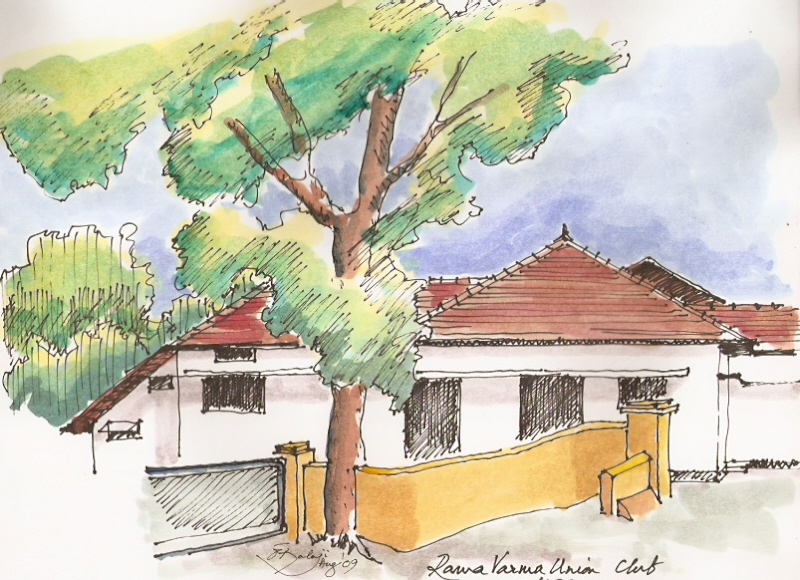
The first leg of our holiday trip was by train. We took an overnight train to Kottayam where a friend had booked a guest room in one of the local clubs. Although quite disappointed with my choice of a holiday destination, my wife put on a brave and cheerful face. We freshened up, had breakfast and while my wife listened to some music on her iPod, I went out and made a couple of quick sketches of our first stop.